


At Buyers Uruguay, we work with buyers who come to Uruguay with very different objectives.
Second homes
In areas such as Punta del Este, Punta Ballena, La Barra, Manantiales, José Ignacio and the Rocha coastline, a search may include anything from apartments and houses to properties in gated communities or country estates. It may also extend to rural or low-density areas, depending on the setting each buyer is looking for. Colonia del Sacramento and Carmelo can also form part of this type of search, particularly for buyers who value their proximity to Buenos Aires.
For many buyers, the decision begins with the idea of having a place of their own for holidays, spending part of the year in Uruguay or having a base they can return to throughout the year. Some prioritise proximity to the coast; others are looking for privacy, nature, more land or simply a quieter setting away from city life.
A central part of the search is understanding how the buyer intends to use the property: how often they will travel, who will use it, how much maintenance they are prepared to take on, the level of privacy they are looking for, and the importance they place on services, access, connectivity and the surrounding environment.
In some searches, a specific location is the starting point. In others, the characteristics of the property and its setting matter more than the name of a particular area. A degree of geographic flexibility can open up alternatives that may respond more closely to what the buyer is actually looking for.
As the way a second home is used can change over the years, we also consider how that decision may evolve over time.
Family relocation
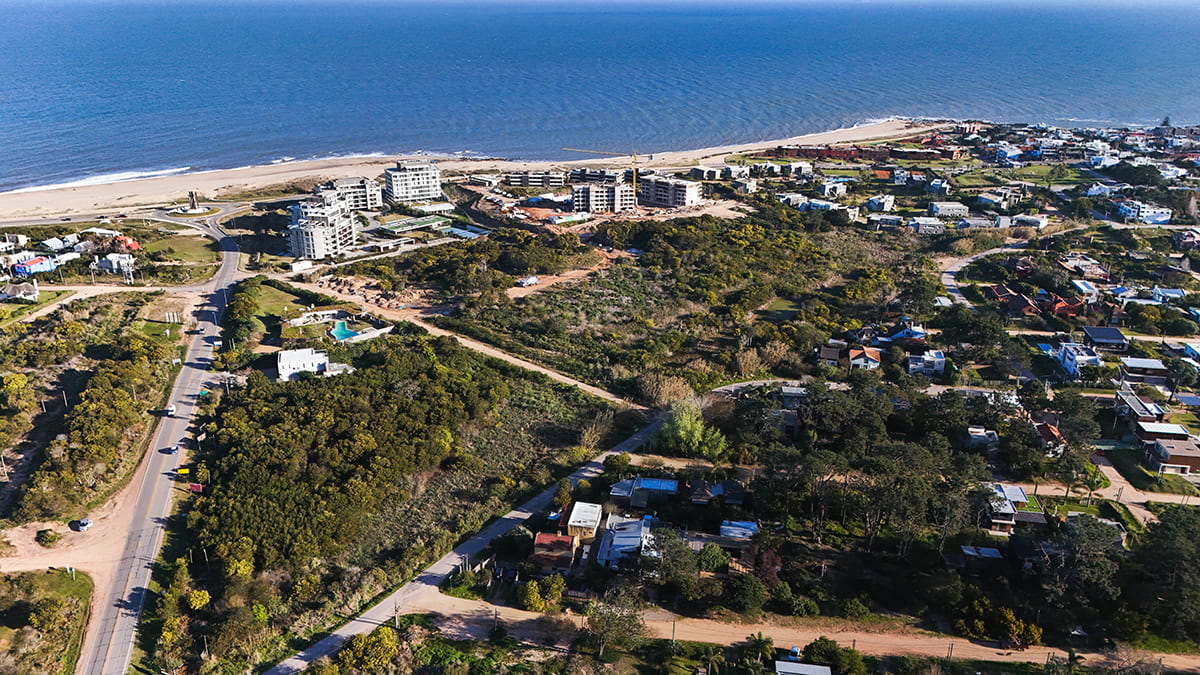
In Montevideo, Ciudad de la Costa, Maldonado and other parts of the country, depending on each family’s needs.
We work with families relocating to Uruguay from Argentina, Brazil, the United States, Canada, different European countries and elsewhere in the world.
Understanding how a family lives today in its country of origin helps us identify which aspects of their life they want to retain, which they want to change, and what type of property and setting may suit this new stage in Uruguay.
Their routines, need for privacy, the spaces they use, their relationship with outdoor areas and the lifestyle they are looking for all form part of that analysis.
Proximity to schools, workplaces and services also matters, as do connectivity, commuting times and how each area functions throughout the year. Some relocations require larger properties, homes capable of accommodating larger families or houses with land for those looking for a less urban way of life.
Before, during and after the purchase
Our involvement can begin before the family travels to Uruguay and continue throughout the search, the purchase and their subsequent relocation to the country.
From the outset, our co-founder and lawyer handles matters relating to residency, documentation, legal and tax considerations, and coordinates the banking arrangements connected with the transaction.
When a family requires it, we can also facilitate other aspects of their relocation by presenting options for architects, interior designers and other trusted professionals and service providers. The choice and appointment of any such professional always remains with the client.
Private Family Estates and Family Compounds
In different parts of the country, according to each family’s priorities.
Some searches require properties of an unusual scale or configuration. Larger families, or several generations of the same family, may need a substantial main residence, several homes within the same property, or enough land to combine shared spaces with different levels of privacy and independence.
In these cases, beyond the number of bedrooms and the total built area, we analyse the layout of the spaces, existing buildings, possibilities for expansion, accommodation for household staff, water supply, energy and sanitation capacity for the entire group, access, privacy, the land itself and how the property will function on a day-to-day basis.
In this type of search, the property and the land carry more weight than a specific location.
Country estates and rural properties
In Maldonado, Rocha and other parts of the country, depending on the setting and characteristics each buyer is looking for.
Not everyone buying land in Uruguay is looking to develop a productive activity. Some want a place to spend part of the year; others are looking for a property where they can live permanently. The amount of land can vary considerably depending on the project: in these searches, land area alone does not determine whether we are looking at a country estate, a residential rural property or productive farmland.
These searches generally begin from one of several different situations: a property with a house that is ready to use; a property with existing buildings that require renovation or extension; or undeveloped land where the buyer intends to build their own home. Each alternative involves different costs, timelines and due-diligence requirements.
Where a property does not have all the necessary infrastructure, there are practical questions that need to be addressed from the outset: whether there is an OSE water connection, an existing well or borehole, or whether a new water source will need to be developed; the availability and quality of that water; whether the UTE electricity network reaches the property or requires an extension; and whether complementary energy solutions make sense. We also analyse year-round access, topography, drainage, flood risk and the general characteristics of the land.
If the buyer intends to build, renovate or extend, we verify what the regulations applicable to that particular property actually allow: land classification, permitted uses, building conditions, setbacks, the number of buildings allowed and any other territorial or environmental restrictions. Minimum subdivision sizes also vary in rural areas: as a general rule, they are 3 hectares in Maldonado and 5 hectares in Rocha, although each case must be reviewed according to the individual property and the applicable planning regulations.
Depending on the property, we coordinate with surveyors to verify area, boundaries and subdivision possibilities; with agronomists when the condition of the soil or its potential productive use needs to be assessed; with water specialists and drilling companies to evaluate water-supply alternatives; and with architects and engineers to assess existing buildings or the viability of a new project.
On the legal side, we verify title, easements, possessory status and any other matters that could affect the property before the buyer assumes a purchase commitment.
Proximity to the coast, views, privacy and the surrounding environment carry different weight depending on each buyer’s brief. For some, these are essential conditions; for others, more land, better access or a property that allows the intended project to be developed matter more than proximity to the coast.
Productive farmland
Across Uruguay’s main agricultural, livestock and forestry regions.
The farmland market varies considerably according to productive potential, location and intended use. Grain production has a strong presence in southern Uruguay and along the western region; rice production is concentrated across three main regions —East, Central and North–Western Littoral— while forestry has a particularly significant presence in Rivera, Río Negro, Tacuarembó and Paysandú.
When searching for productive farmland, we therefore analyse not only land area and price, but also location, land value and the intended use of the property. Where appropriate, we coordinate with a trusted agronomist to assess soils, the CONEAT index, productive potential and water availability. We also consider access, improvements and infrastructure.
CONEAT is an official MGAP index that expresses the relative productive capacity of different soil groups. It is an important reference when assessing farmland, although market value also depends on location and the other characteristics of the property.
In 2025, according to MGAP-DIEA’s Land Price series, the average price of transactions involving agricultural land of 10 hectares or more was USD 4,178 per hectare. There were significant differences between departments: Colonia averaged USD 9,707/ha, while Artigas recorded USD 2,300/ha. These figures illustrate why price per hectare alone is not enough to compare two farms.
Rental and investment properties
Primarily in Montevideo and Maldonado.
For buyers purchasing with the aim of generating rental income, one- and two-bedroom apartments often play a central role, although the strategy varies according to the location and the type of rental being considered.
In Montevideo, the focus is generally on more consistent demand throughout the year. In Maldonado and Punta del Este, seasonality may play a greater role, together with the possibility of combining short-term rentals with personal use during part of the year.
The search may also include off-plan developments, properties under construction or projects approaching completion, depending on the stage of the development and the investment objective.
In developments declared under Uruguay’s Vivienda Promovida regime, a property intended for long-term rental, with leases of at least 12 months, may qualify for tax benefits on rental income and Wealth Tax. The regime also applies to non-resident owners. On the first transfer, an exemption from property transfer tax (ITP) may also apply to both buyer and seller, within the period established by law.
These benefits depend on the conditions applicable to each development, the intended use of the property and the exemption period that remains in force from the completion of the building. They therefore form part of the overall investment analysis.
Returns depend on more than the expected rent. The acquisition price, service charges, vacancy periods, management costs, tax treatment, local demand and resale prospects all need to be considered.
For that reason, we look for properties whose rental potential and purchase terms make sense in relation to the price being paid.
Commercial properties, warehouses and land for companies
Primarily in Montevideo, Ciudad de la Costa and Maldonado, although the location depends on the nature of each business.
For a company entering Uruguay or expanding its operations in the country, the property search can take many different forms. It may involve premises for a retail, hospitality or service business, but it can also mean a warehouse, industrial facility, workshop or land on which to develop purpose-built installations.
The location needs to work for the business. For activities that depend on customer traffic, we analyse visibility, pedestrian and vehicle flow, access, parking and how demand behaves throughout the year. In Punta del Este and other parts of Maldonado, seasonality can also significantly affect the suitability of a location.
For a logistics or distribution company, connections to major roads, the port or the airport, as well as access for freight vehicles, may carry greater weight. A company involved in machinery, industry or technical services may require larger areas, storage space, workshops, outdoor yards or room for the movement of vehicles and equipment.
We search both existing properties and land where the operation can be developed. Before proceeding, we verify whether the intended use is viable in that location, considering zoning, permitted uses, applicable departmental regulations and the licensing requirements for the activity.
When the project requires it, we coordinate with a trusted architect and engineering firm to assess the property technically and evaluate its potential for adaptation or development.
If you are considering a purchase in Uruguay, we can discuss your search confidentially and review opportunities both on the market and off-market.
Contact us for an initial conversation about what you are looking for.
Let’s talk about your search